
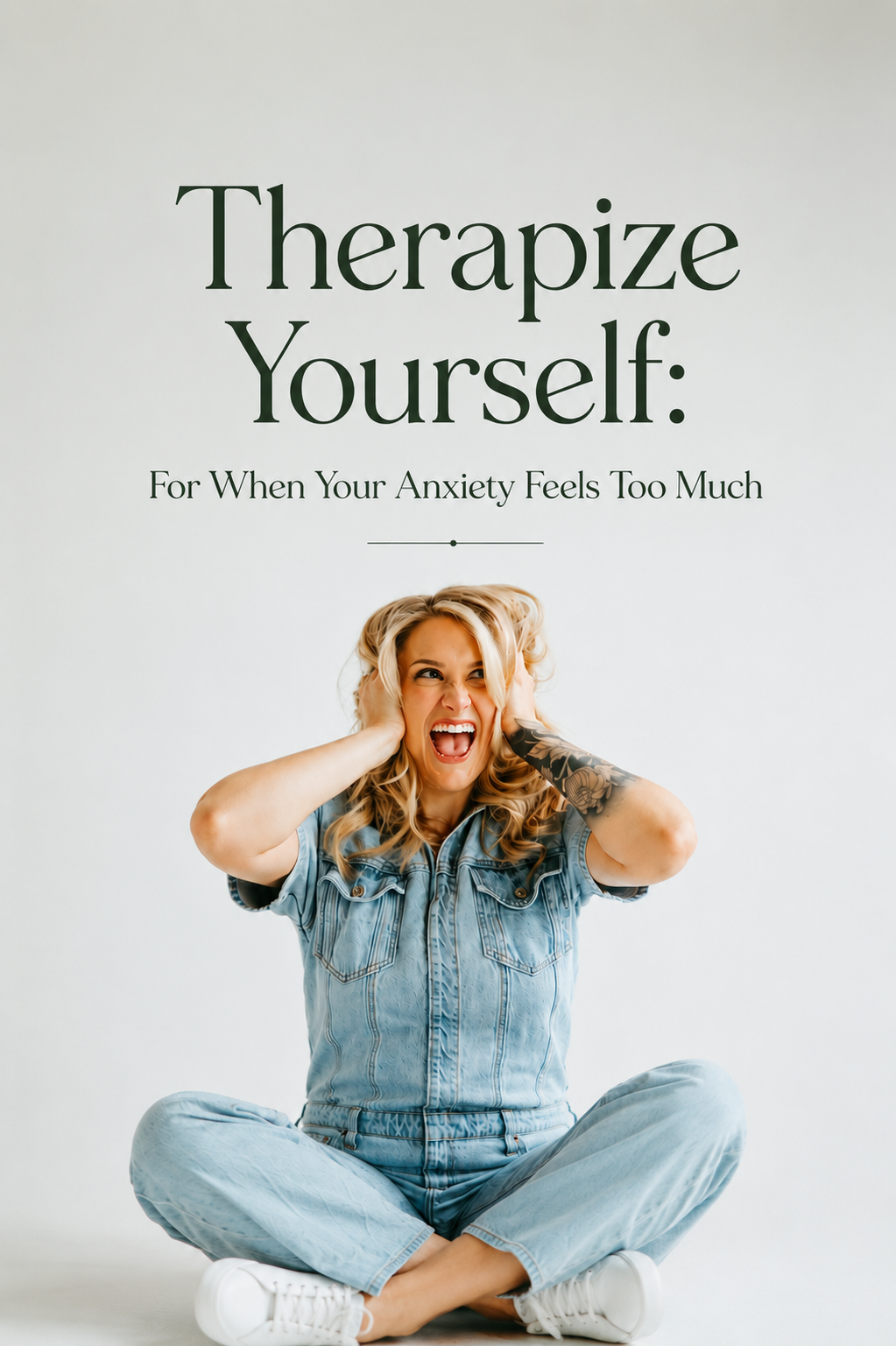
A step-by-step somatic worksheet designed for moments when anxiety feels overwhelming.
This guide walks you through simple, body-based exercises to calm your nervous system — no overthinking required. Each exercise takes just a few minutes and can be done individually or in sequence.
For the person who can explain exactly why they’re anxious…and still can’t make it stop.
Maybe you’re the person who:
• Replays conversations long after they’re over
• Feels physically tense even when nothing is technically wrong
• Knows you’re overthinking but can’t seem to turn it off
• Goes from “I’m fine” to completely overwhelmed way too quickly
• Can rationalize your way through the anxiety but still feel it in your chest, stomach, jaw, or shoulders
• Has tried all the coping skills and still wonders, “Why am I like this?”
Here’s what I want you to know:
You probably don’t need to get better at thinking your way out of anxiety.
You need tools that work with the part of you that’s actually sounding the alarm.
Your brain knows you’re safe.
Now let’s get your body on board.
You’ve talked yourself through the anxiety.
You’ve reminded yourself that everything is fine.
You’ve tried deep breathing, distracting yourself, going for a walk, journaling, and telling yourself to just stop overthinking.
And somehow your chest is still tight, your mind is still racing, and your body is still acting like something is very, very wrong.
That’s because anxiety isn’t always a thinking problem.
Sometimes your nervous system needs more than another pep talk.

You can’t always think your way out of something your body is experiencing.
A lot of anxiety advice focuses on your thoughts:
Challenge the thought. Think positively.
Remind yourself you’re safe. Stop catastrophizing.
And those tools can be helpful.
But there’s a frustrating gap between knowing you’re okay and actually feeling okay.
You can understand exactly where your anxiety comes from and still have a nervous system that reacts like something is wrong.
That doesn’t necessarily mean you need more insight.
You might need a different way of responding to the anxiety.
Your anxiety doesn't always need another argument.
When anxiety shows up, most of us immediately go upstairs to our brain.
Why am I feeling this?
Is this rational?
What if this happens?
Okay, calm down.
And suddenly you’re trying to outthink the overthinking.
Somatic tools take a different approach.
Instead of asking your brain to argue harder with your anxiety, these exercises help you work with what’s happening in your body and nervous system.
Less “I know I shouldn’t be anxious.”
More “I know what to do when anxiety shows up.”


Imagine anxiety showing up…and actually knowing what to do with it.
Your heart starts racing before a difficult conversation.
Your thoughts start spiraling at 11 PM.
You notice yourself getting overstimulated, tense, restless, or completely stuck in your head.
But instead of immediately getting swept up in it, you have something to reach for.
A tool.
A practice.
A way to help your body come back down.
The goal isn't becoming someone who never feels anxious.
It's becoming someone who trusts herself to know what to do when she does.
Meet Therapize Yourself: For When Your Anxiety Feels Too Much
A therapist created digital worksheet designed to help you build a body based toolkit for the moments when your anxiety isn't responding to logic.
Inside, you’ll find simple somatic exercises you can actually practice and come back to when anxiety hits.
Use them to help you:
• Calm your body when anxiety feels physical
• Interrupt the anxiety spiral before it completely takes over
• Get out of your head and reconnect with your body
• Understand what your nervous system may need in the moment
• Build a toolkit you can return to instead of Googling “how to stop anxiety” for the 47th time
No 87 page workbook you’ll download and never open.
No pretending one breathing exercise is going to change your life.
Just practical tools you can actually use when your nervous system is doing the absolute most.
Created by a trauma therapist who works with people who are very good at understanding themselves.
I’m Hannah, a trauma therapist and owner of Revive Therapy Services.
A lot of the people I work with aren't lacking insight.
They've been to therapy. They've read the books. They know their attachment style. They can tell you exactly where their anxiety comes from.
And they're still anxious.
My work focuses on helping people move beyond understanding their patterns intellectually and start working with what’s happening in their nervous system, too.
I created Therapize Yourself: For When Anxiety Feels Too Much to give you some of the body based tools that can help bridge that gap.

“But I’ve already tried coping skills…”
Good. This isn't about throwing everything you've learned away.
Somatic tools give you another way to respond when knowing what to think isn't changing what you're feeling.
You don't need experience with somatic therapy.
You don't need to be “good” at regulating your nervous system.
And you definitely don't need to use every exercise every time you're anxious.
The point is to experiment with different tools and start learning what actually helps your nervous system settle.
You already know how to understand yourself.
Now learn how to help your body feel what your brain already knows.
You don't need another thing to analyze about your anxiety.
You need something you can do when it shows up.
Keep the worksheet on your phone.
Print it out.
Come back to it when your brain is moving 100 miles an hour and you can't remember a single coping skill you've ever learned.
A step-by-step somatic worksheet designed for moments when anxiety feels overwhelming.
This guide walks you through simple, body-based exercises to calm your nervous system — no overthinking required. Each exercise takes just a few minutes and can be done individually or in sequence.